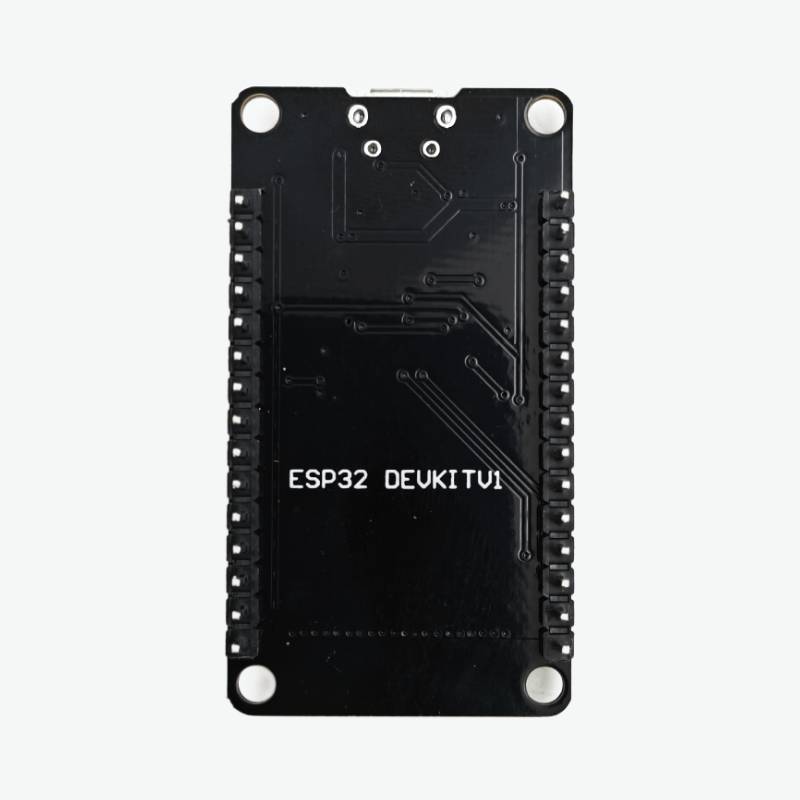
ESP32 30-Pin CP2102 Development Board with Wi-Fi and Bluetooth
ESP32 30-Pin CP2102 Development Board with Wi-Fi and Bluetooth
Couldn't load pickup availability
The ESP32 30-Pin Development Board delivers robust performance for smart automation and connected electronics. Driven by the ESP-WROOM-32 module with a dual-core Tensilica Xtensa 32-bit LX6 microprocessor running at up to 240MHz, it provides smooth processing power alongside 520KB SRAM and 4MB Flash memory.
Equipped with integrated 2.4GHz Wi-Fi and dual-mode Bluetooth (Classic and BLE), this compact board offers versatile wireless communication. Its 30-pin layout ensures broad hardware compatibility across ADC, DAC, PWM, I2C, SPI, and UART interfaces, while the built-in USB-to-serial interface and micro USB port allow simple plug-and-play programming.
Key Features
| Product Type | Development Board |
| Chipset | ESP-WROOM-32 |
| Microcontroller | Tensilica Xtensa Dual-Core 32-bit LX6 |
| Clock Speed | Up to 240MHz |
| Flash Memory | 4MB |
| SRAM | 520KB |
| Wi-Fi | IEEE 802.11 b/g/n (2.4GHz) |
| Bluetooth | v4.2 (Classic + BLE) |
| Pin Count | 30 Pins |
| USB Interface | Micro USB (via CP2102/CH340) |
| Operating Voltage | 3.3V Logic / 5V USB Input |
| Mounting Type | Breadboard-compatible |
| Supported Interfaces | ADC, DAC, PWM, I2C, SPI, UART |
| Antenna Type | Integrated PCB Antenna |
| Weight | 10 g |
Highlights
- Dual-core 32-bit LX6 microprocessor
- Integrated 2.4GHz Wi-Fi and Bluetooth (Classic + BLE)
- 30-pin layout for compact form factor
- 520KB SRAM + 4MB Flash memory
- Multiple GPIOs with support for ADC, DAC, PWM, I2C, SPI, UART
- PCB antenna for wireless communication
- Built-in USB to Serial (CP2102/CH340) for programming
- Low-power consumption with multiple sleep modes
- Ideal for IoT, automation, robotics, and sensor networks
Compatibility
Compatible with Arduino IDE, ESP-IDF, MicroPython, and standard 3.3V sensor modules and breadboard systems. Interfaces seamlessly with devices communicating via I2C, SPI, UART, PWM, ADC, and DAC protocols.
How to use
Connect the board to your computer using a standard micro USB cable to supply power and establish serial communication. Use compatible development environments such as Arduino IDE or ESP-IDF to write and flash firmware. Connect sensors and peripherals directly to the 30 breadboard-friendly GPIO header pins using standard jumper wires.
What's included
1 × ESP32 Development Board with Wi-Fi and Bluetooth – 30 Pin – ESP-WROOM-32 Module
Frequently asked questions
|
Share